
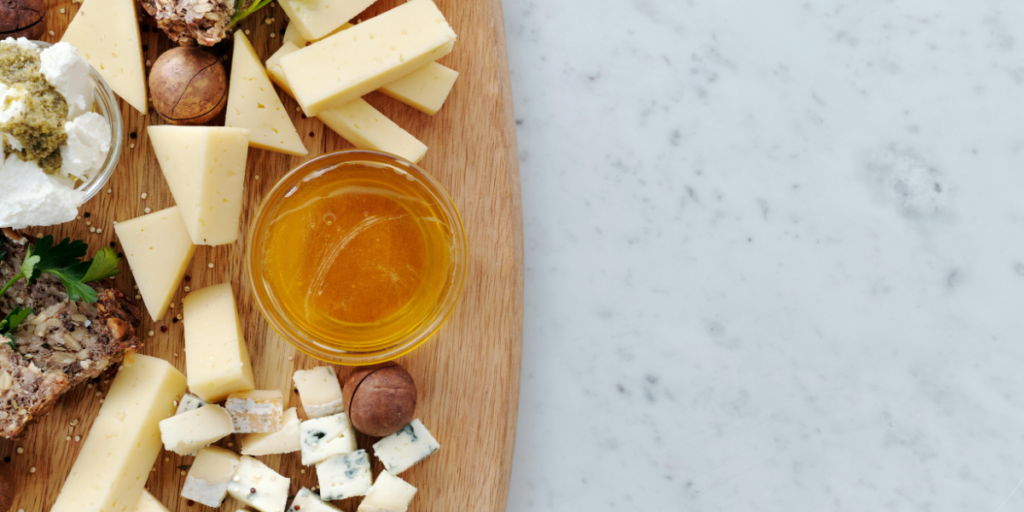
Everyone has assembled a cheese board at some point. You grab a wedge of something aged, something creamy, maybe a soft brie, a handful of crackers, some grapes, and a cluster of supermarket olives. You arrange it on a cutting board, set it on the table, and call it done. It looks the part. Guests nibble. The conversation moves on.
Now think about the best cheese board you have ever encountered — the one where you found yourself going back again and again, trying combinations, reaching over other people, lingering at the table long after the dinner conversation had moved somewhere else. What made it different?
The answer, almost always, is not the cheese. It is everything around the cheese. The quality of the oil set out for dipping. The balsamic that turned a plain cracker and a sliver of aged manchego into something almost dessert-like. The olives that were brined rather than simply preserved, stuffed with something unexpected, vivid rather than flat. The accompaniments, in other words, are what make a cheese board genuinely extraordinary — and those elements are where most home hosts consistently underinvest.
At The Olive Bar in downtown Campbell, the approach to building a great cheese board starts with understanding that olive oil and aged balsamic vinegar are not condiments. They are co-stars. And once you start treating them that way, every board you put together becomes an entirely different experience.
The Cheese Is the Anchor, Not the Whole Story
It would be wrong to dismiss the importance of the cheese itself. Variety and contrast matter enormously. A board built from a single flavor profile — all mild, all aged, all bold — becomes monotonous quickly. The most reliable structure is to choose cheeses that differ in texture, origin, and intensity: one fresh or soft-ripened cheese like burrata, chèvre, or Brie; one semi-firm option like young manchego, Havarti, or Fontina; and one aged or assertive variety like Gruyère, Parmigiano-Reggiano, or a sharp aged cheddar. If you want to go further, a blue-veined cheese or a smoked variety adds a fourth dimension that gives the board real range.
The International Olive Council has extensively documented the relationship between high-quality extra virgin olive oil and dairy — particularly how the polyphenol compounds and fresh fruit aromatics in real EVOO interact with the fat structure and lactic acidity of aged and fresh cheeses. This is not an abstract chemistry point. It is a sensory reality that Mediterranean cultures have understood for thousands of years, and it is the foundation of why a board featuring genuinely excellent olive oil feels so different from one where the oil is an afterthought.
Temperature matters too. Cheese served directly from the refrigerator is blunted — its aromatics muted, its textures stiffer than they should be. Pulling your cheeses out thirty to forty-five minutes before guests arrive is a simple and often overlooked step that meaningfully improves everything on the board.
Why Real Olive Oil Is a Non-Negotiable
A small ramekin of extra virgin olive oil alongside bread or crackers is one of the most elegant and low-effort additions you can make to a cheese board — but only if the oil is genuinely good. Mass-market olive oils, many of which fail independent quality testing and may be blended or oxidized by the time they reach a grocery store shelf, do not deliver the flavor complexity that makes oil-and-bread-dipping the experience it is supposed to be. The United States Department of Agriculture maintains grading standards for olive oil, but those standards do not always reflect the difference in taste and freshness that separates a premium single-varietal oil from a commodity blend.
The Olive Bar’s collection of extra virgin olive oils is built around the principle that variety and freshness are everything. Different olive cultivars produce oils with dramatically different flavor characters, and matching those characters to the cheeses on your board is one of the more satisfying decisions you can make as a host.
For a board anchored by mild, creamy cheeses — burrata, fresh chèvre, young brie — reach for a softer, more delicate oil. The Arbequina varietal is buttery, with mild almond and apple notes and a finish so gentle it does not compete with the dairy. It is the kind of oil that makes guests say something tastes rich without being able to identify exactly why. Set it in a small dish near sliced bread and watch it disappear.
For a board featuring bold, aged cheeses — sharp cheddar, Gruyère, aged manchego, Parmigiano-Reggiano — you want an oil with enough backbone to stand alongside the intensity. Koroneiki, the dominant cultivar of Greece and one of the world’s oldest olive varieties, brings herbaceous, grassy aromatics and a long peppery finish driven by oleocanthal, the polyphenol compound that also gives high-quality EVOO its throat-catching quality. As explored in The Olive Bar’s deep dive on polyphenols versus standard antioxidants, oleocanthal shares a biochemical mechanism with ibuprofen — which helps explain why the pepper sensation feels so clean and distinct rather than sharp or harsh.
And then there are the infused oils, which open up an entirely different dimension on the board. The Olive Bar’s White Truffle extra virgin olive oil alongside a rind-washed cheese or aged pecorino is earthy and aromatic in a way that makes even a plain cracker feel like a course at a restaurant. Roasted Garlic infused oil near the bread end of the board gives guests a savory option that bridges cheese and cured meat without requiring any additional preparation. These are not novelty products — they are thoughtful flavor tools, and a board that uses them well rewards every guest who pays attention.
Aged Balsamic as the Finishing Note
If olive oil is what you dip into, aged balsamic vinegar is what you drizzle over — and the distinction between a traditionally aged balsamic and the caramel-thickened, vinegar-based product sold in most grocery stores is the same as between a single-estate wine and a gas-station bottle. Both are technically balsamic. Only one earns the description.
The Olive Bar’s aged balsamic vinegars are produced in the Modena barrel-aging tradition — reduced grape must concentrated over time, moving through barrels of decreasing size and different wood types, developing the syrupy body, natural sweetness, and layered complexity that make them genuinely indispensable on a well-built board. A small drizzle over the right cheese does not just add sweetness. It adds acidity that lifts the fat, sweetness that amplifies salt, and depth that gives the whole bite a resolution it would otherwise lack.
The pairing logic is worth understanding because it makes every decision intuitive rather than guesswork. Sweeter, fruit-forward balsamics — Fig, Strawberry, Pomegranate, Blackberry Ginger — work beautifully against bold, salty, or pungent cheeses because the sweetness provides contrast and the fruit’s acidity cuts through the intensity. Darker, more complex balsamics — Traditional Dark, Dark Espresso, Honey Ginger — complement mild or creamy cheeses by adding depth and complexity that the cheese alone does not supply.
The table below offers a practical reference for pairing across a five-cheese board:
| Cheese | Oil Pairing | Balsamic Drizzle |
|---|---|---|
| Fresh burrata or chèvre | Arbequina EVOO | Fig or Strawberry Balsamic |
| Young manchego or Havarti | Frantoio EVOO | Pomegranate Balsamic |
| Aged cheddar or Gruyère | Koroneiki EVOO | Dark Espresso Balsamic |
| Brie or camembert | White Truffle infused oil | Blackberry Ginger Balsamic |
| Gorgonzola or blue | Picual EVOO | Honey Ginger Balsamic |
None of these pairings are rules — they are starting points. The real benefit of shopping at The Olive Bar is the tasting experience, which allows you to sample oils and balsamics side by side before committing. The art of pairing olive oil and balsamic vinegar is something The Olive Bar has built its entire identity around, and it translates directly to the cheese board context.
Gourmet Olives and the Rest of the Board
Olives belong on a cheese board — not as a garnish, but as a flavor presence in their own right. The Olive Bar’s gourmet olive selection includes lemon-stuffed, almond-stuffed, jalapeño-stuffed, and a range of marinated options that bring brininess, acidity, and textural variety that jarred supermarket olives simply cannot replicate. Place them in a small ceramic dish at one corner of the board so their liquid stays contained, and let guests discover them as they move across the spread.
Beyond the olives, the supporting cast of a great cheese board includes thin-sliced prosciutto or salami, fresh grapes or sliced pears, roasted nuts, dried dates or apricots, and a mix of crackers and artisan bread. The bread in particular is where the olive oil and bread dipping experience finds its natural home on the board — sliced baguette near the oil ramekin is an invitation that almost no guest can pass up.
What all of these elements share is their role as bridges. A slice of prosciutto alongside an aged cheese and a drizzle of pomegranate balsamic is not three ingredients — it is one experience. The board works when its components are chosen to create those bridging moments, and that only happens when the foundational elements — the oil, the balsamic, the olives — are worth building around.
Building a Board That People Remember
The practical work of assembling a cheese board takes twenty minutes at most. Anchor the cheeses first, spacing them across the board so each has its own zone. Fill the spaces between them with accompaniments, working from largest to smallest elements. Position oil ramekins near the bread. Drizzle balsamics last, just before guests arrive, so the vinegar is fresh and aromatic when the board hits the table. A sprig of fresh rosemary or thyme tucked into a corner is a small touch that signals intention and adds a faint herbal fragrance that makes the whole board feel more alive.
What makes a board memorable is not abundance. It is curation. A board with four excellent, well-matched components will outperform a board with twelve mediocre ones every single time — because the guest’s experience of discovery, of trying one thing and then reaching for something adjacent to see how the combination changes, is only possible when each element is genuinely worth returning to.
The Olive Bar exists precisely for this kind of intentional, ingredient-first approach to food. Whether you are building a board for two on a Tuesday evening or setting out a spread for twenty at a holiday gathering, the difference between fine and extraordinary lives in the details — and those details are available to taste, explore, and bring home from Campbell. Visit us in store or shop the full collection online to find everything you need for a board that earns a permanent place in your entertaining rotation.
Frequently Asked Questions
What olive oil should I use on a cheese board? The right olive oil for a cheese board depends on the cheeses you are featuring — mild, creamy varieties pair best with softer, more delicate oils like Arbequina, while aged and bold cheeses benefit from an oil with more intensity, such as Koroneiki or Picual. Infused oils like White Truffle or Roasted Garlic add aromatic dimension that works particularly well alongside bread and soft-rind cheeses. The Olive Bar’s tasting experience lets you sample before you buy, making it easy to find the right match for your specific board.
How do I use balsamic vinegar on a cheese board? Aged balsamic vinegar is best used as a finishing drizzle — applied directly over individual cheese portions just before serving, or presented in a small dish for guests to use themselves. The pairing principle is contrast: fruity, sweeter balsamics like Fig or Strawberry complement bold, salty, or pungent cheeses, while darker and more complex varieties like Traditional Dark or Dark Espresso add depth to mild or creamy ones. A small amount goes a long way, and the quality of the balsamic makes an enormous difference in the final result.
How many cheeses should I include on a cheese board? For two to four guests, two to three cheeses is the ideal range — enough to create contrast without overwhelming the board or the budget. For larger gatherings of eight to twelve, four to five cheeses allow for a fuller range of flavor and texture that keeps the board interesting throughout the evening. More important than quantity is contrast: at minimum, include one soft, one semi-firm, and one aged or bold cheese so that guests encounter meaningfully different experiences as they explore the spread.
Where can I find quality olive oil and balsamic vinegar for a cheese board in the Campbell area? The Olive Bar in downtown Campbell is a specialty shop dedicated to extra virgin olive oils, aged balsamic vinegars, infused oils, and gourmet olives — all available for tasting before purchase. The shop carries single-varietal EVOOs sourced from Greece, Spain, Italy, and California alongside more than two dozen balsamic vinegar varieties aged in the traditional Modena barrel style. Shopping at The Olive Bar means making intentional, informed choices rather than guessing from a grocery store shelf, and the in-store tasting experience is one of the more genuinely enjoyable ways to prepare for a great dinner.